Henry Winkler: a name for a lifelong struggle
His stepson's assessment helped the actor recognize his own dyslexia—and reconsider the school difficulties he had carried into adulthood.
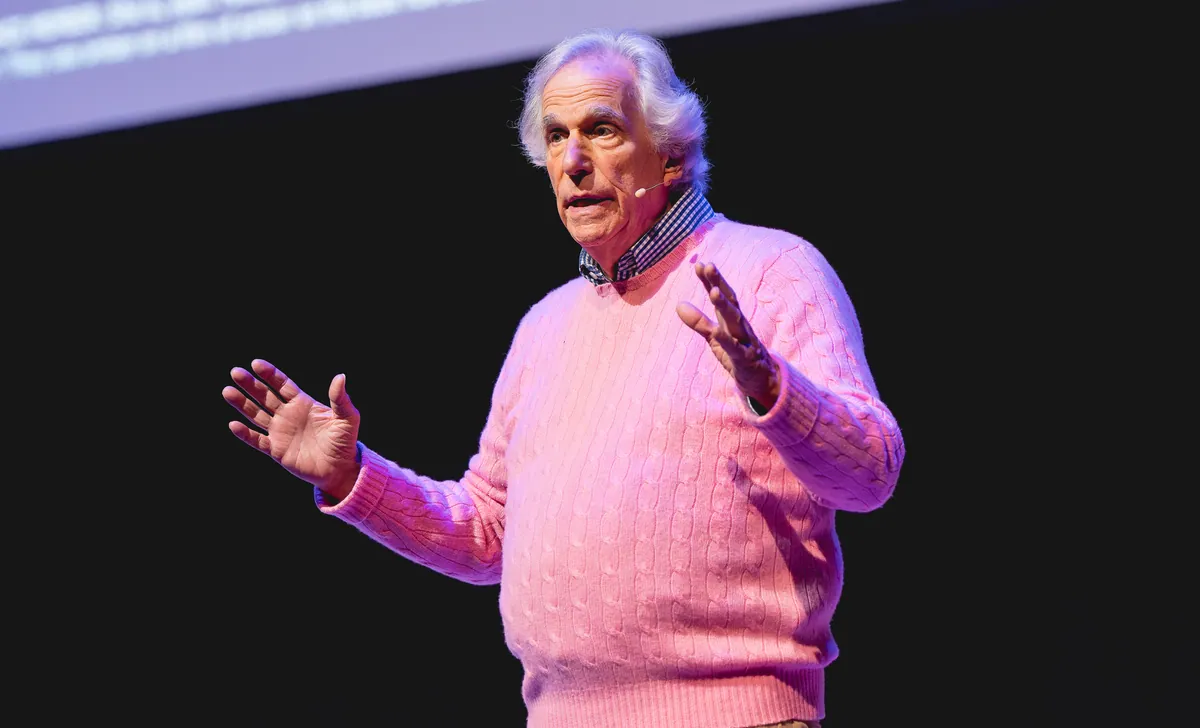
Henry Winkler at the Barbican Centre in 2024.
“HenryWinklerBarbican210624 (22 of 29)” — Raph_PH, via Wikimedia Commons (CC BY 2.0). Resized and converted to WebP.
Henry Winkler’s confidence on screen concealed a very different experience of school. Before audiences knew him as the Fonz, he was a child who wanted to do well and could not understand why reading and spelling were so difficult. Being told to work harder did little to explain what was happening.1
In his account for Yale’s dyslexia center, Winkler remembers being called lazy and falling short of his parents’ expectations. He could prepare carefully and still struggle when a test arrived. The problem followed him for years without a name. He did not recognize his own dyslexia until he was 31.1
The turning point came through his stepson, Jed. When Jed struggled to write a school report, Winkler initially responded with the same pressure he remembered from childhood. Then Jed was assessed and diagnosed with dyslexia. Hearing the explanation, Winkler recognized his own difficulties. An experience he had understood as a personal failure finally made sense in another way.1
There is a reason to ask more specific questions about your abilities, even if school is far behind you. OpenIQ’s AGCT IQ Test brings verbal, quantitative, and spatial problems into one assessment. Working through that variety can help you move beyond a single memory of how you performed in a classroom and start noticing how you approach different kinds of reasoning today.
Winkler’s career had already required him to find practical ways through difficult reading. In a 2023 interview with ABC News, he described stumbling during cast script readings and covering his embarrassment with humor. At home, when reading to his children tired his eyes, his wife read and he acted the story out. The same page could become a different task when he had a part he could perform.2
His professional life kept expanding. The Television Academy records work across acting, producing, directing, and writing, as well as his 2018 Primetime Emmy for Barry. With Lin Oliver, he developed the Hank Zipzer books, drawing on his school experiences to create a resourceful child whose difficulties do not prevent him from having adventures. The series gave young readers a character who could struggle and still be the person driving the story.3
Language itself contains several different challenges. Recognizing a word, understanding a second meaning, following an analogy, and explaining an idea ask different things of a reader. OpenIQ’s AMEX verbal assessment lets you explore vocabulary, knowledge, and verbal reasoning across eight subtests. If you are curious about words, its range of questions offers a more detailed experience than assuming one difficult task tells you how every verbal task will feel.
What stays with us in Winkler’s account is the change in understanding. Once there was an explanation, the years of effort could be seen alongside the difficulty. His ability to perform, make people laugh, and tell stories had been there throughout. His later success gave those abilities a public stage, but the more personal shift was learning to describe himself without borrowing the harsh judgments he had heard at school.2
OpenIQ makes room for that kind of curiosity about yourself. Explore an assessment, pay attention to the questions as well as the score, and give your strengths a chance to become more specific than a label.