Temple Grandin: making room for different minds
The animal scientist describes how visual thinking, encouragement, and the chance to show her drawings helped her build a career.
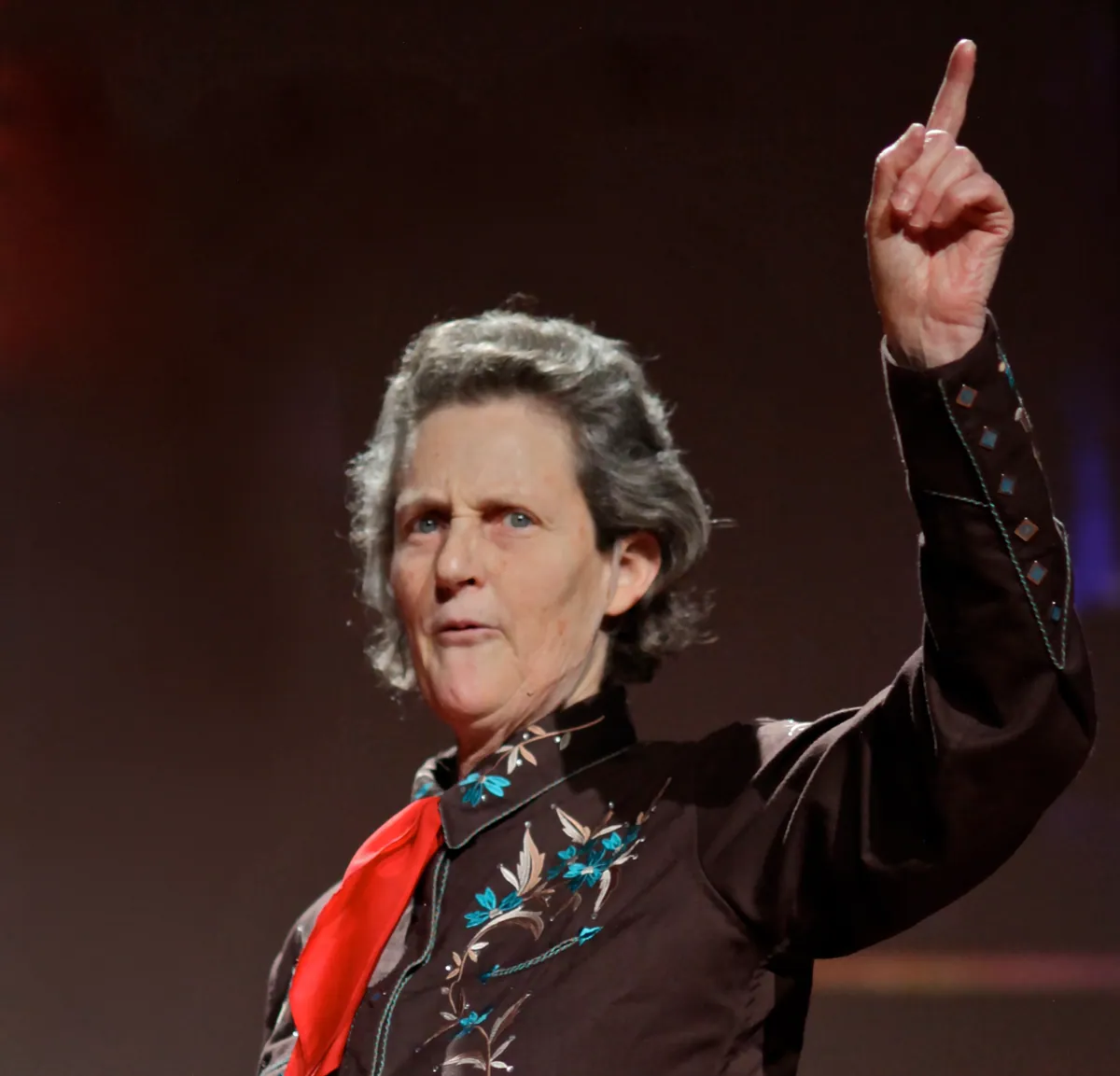
Temple Grandin at TED in 2010.
“Rain Man’s Rainbow” — Steve Jurvetson, via Wikimedia Commons (CC BY 2.0). Resized and converted to WebP.
When Temple Grandin looks at an animal-handling facility, she imagines what the animal will see as it moves through it. A shadow, a reflection, or a change in the floor can become the detail that explains a problem. Her visual thinking gave her a way to notice things that other designers had overlooked.2
Grandin describes her thoughts as photographic images. On her official website, she explains that she once assumed everyone thought that way. She could picture designs before they were built, yet found algebra difficult because she had little to visualize. Recognizing that other people processed the same information differently changed how she understood both her own abilities and theirs.2
That is an inviting question to explore for yourself: what happens when a problem is something you can see and manipulate? In OpenIQ’s Mindspace, you can rotate structures, remember the positions of objects, and track movement directly. The objects are part of the activity. You can try a spatial task and notice the strategy you reach for, whether you picture a turn, follow a landmark, or keep a pattern in mind.
In a Colorado State University interview, Grandin recalled difficult high-school years and the relief she found in practical activities: riding horses, making model rockets, and working in an electronics lab. Those were settings with something concrete to do. Encouragement from other people mattered, too. When she began showing her drawings, she could put a visible example of her skill in front of someone.1
Her approach to livestock design followed that attention to detail. A University of Missouri account describes how she studied lighting, shadows, floor texture, and the position of handlers to understand why cattle became fearful or stopped moving. Following the animal’s view of a space could reveal a problem that was easy for a person standing outside it to miss. Observation became a practical design tool.3
Grandin also makes a clear case for collaboration. In the CSU interview, she describes being able to visualize an experiment while a mathematically skilled colleague contributes the statistics. The project needs both. Her teaching asks students to observe animals closely and design an actual handling facility, bringing their reasoning to a problem with physical consequences.1
OpenIQ’s AGCT IQ Test gives you another way to explore the relationship between kinds of reasoning, with verbal, quantitative, and spatial questions in one assessment. If numerical problems are what interest you, the GRE Math Test offers a focused next step. Moving between formats can make your own preferences easier to notice: you might find a diagram useful, enjoy working with a relationship between numbers, or prefer a problem you can explain in words.
Grandin’s career gives those differences a human scale. A drawing can communicate an idea before its maker has found the words for it. A careful observation can change a design. A collaborator can contribute the piece another person finds difficult. Her account encourages us to look for useful abilities in the work people actually do, and to create more opportunities for those abilities to become visible.
Start with a kind of problem that makes you curious. OpenIQ’s free assessments and interactive activities offer different ways into that exploration—and more chances to discover what feels natural, challenging, or worth another look.